What is actually inside two Gelagen gummies: the Supplement Facts panel transcribed, how to read the Daily Values, the gummy base, and an NIH source for every nutrient on the label.

Editorial disclosure: gelagenguide.com is an independent guide and is not the manufacturer, distributor or seller of Gelagen. It contains affiliate links, and we may earn a commission if you purchase through them, at no extra cost to you. These statements have not been evaluated by the Food and Drug Administration. Gelagen is not intended to diagnose, treat, cure, or prevent any disease. Consult a healthcare professional before use.
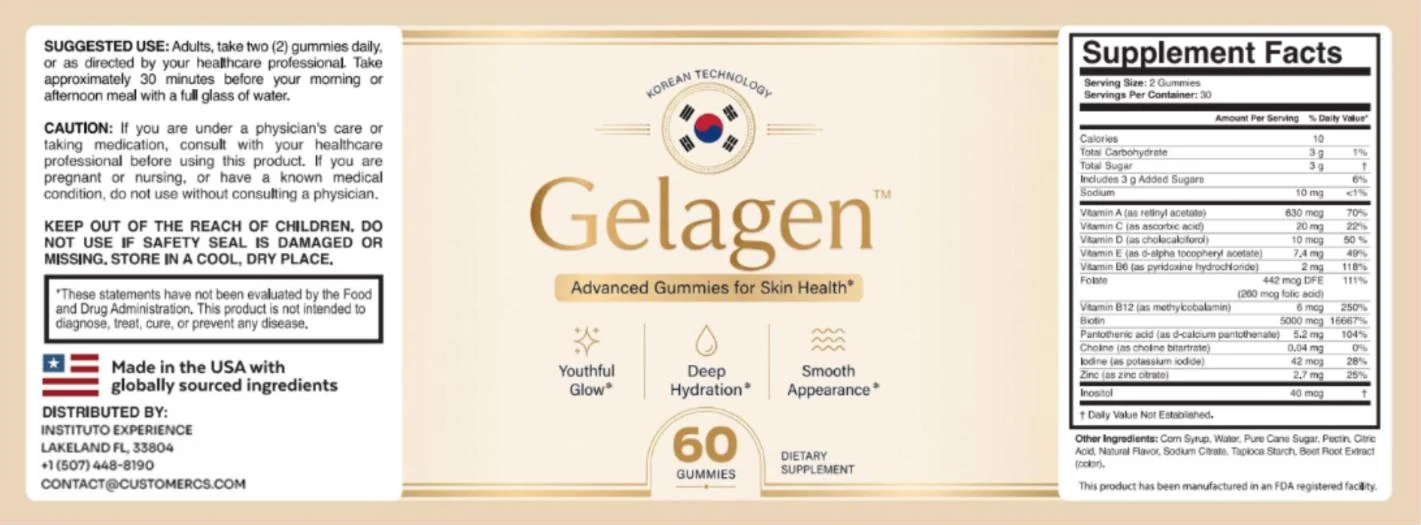
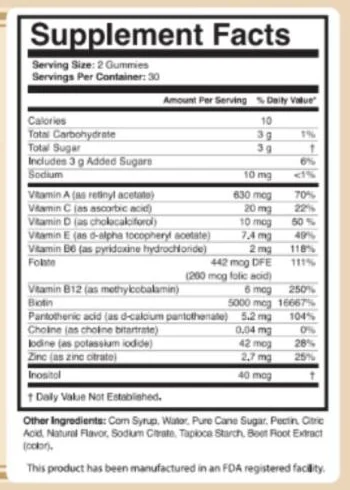
The Gelagen ingredients list below is transcribed from the label image on the official order page. One serving is two gummies, and every nutrient has its own amount. Click any picture to see it full size.
| Serving size | 2 gummies |
|---|---|
| Servings per container | 30 (60 gummies per bottle) |
| Calories | 10 |
| Total carbohydrate | 3 g (1% DV) |
| Total sugar | 3 g, all of it added sugar (6% DV) |
| Sodium | 10 mg (<1% DV) |
| Vitamin A (as retinyl acetate) | 630 mcg (70% DV) |
| Vitamin C (as ascorbic acid) | 20 mg (22% DV) |
| Vitamin D (as cholecalciferol) | 10 mcg (50% DV) |
| Vitamin E (as d-alpha tocopheryl acetate) | 7.4 mg (49% DV) |
| Vitamin B6 (as pyridoxine hydrochloride) | 2 mg (118% DV) |
| Folate | 442 mcg DFE, from 260 mcg folic acid (111% DV) |
| Vitamin B12 (as methylcobalamin) | 6 mcg (250% DV) |
| Biotin | 5,000 mcg (16,667% DV) |
| Pantothenic acid (as d-calcium pantothenate) | 5.2 mg (104% DV) |
| Choline (as choline bitartrate) | 0.04 mg (0% DV) |
| Iodine (as potassium iodide) | 42 mcg (28% DV) |
| Zinc (as zinc citrate) | 2.7 mg (25% DV) |
| Inositol | 40 mcg (Daily Value not established) |
| Other ingredients | Corn syrup, water, pure cane sugar, pectin, citric acid, natural flavor, sodium citrate, tapioca starch, beet root extract (color) |
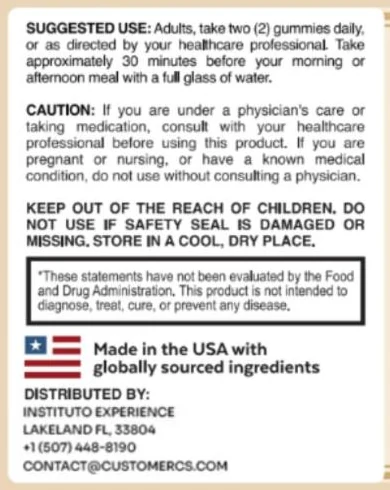
| Suggested use | "Adults, take two (2) gummies daily, or as directed by your healthcare professional. Take approximately 30 minutes before your morning or afternoon meal with a full glass of water." |
| Caution | "If you are under a physician's care or taking medication, consult with your healthcare professional before using this product. If you are pregnant or nursing, or have a known medical condition, do not use without consulting a physician." |
| Storage | "Keep out of the reach of children. Do not use if safety seal is damaged or missing. Store in a cool, dry place." |
| Origin | "Made in the USA with globally sourced ingredients" |
| Distributed by | Instituto Experience, Lakeland, FL 33804 · +1 (507) 448-8190 · contact@customercs.com |
Every amount on the panel is for two gummies, the full daily serving. A bottle holds 60 gummies, so it has 30 servings. Half a serving, one gummy, gives half of each amount.
The right-hand column compares each amount with the Daily Value used on US labels. Over 100% means the serving gives more than that reference amount; biotin reaches 16,667% because its Daily Value is only 30 mcg. A dagger marks inositol, which has no Daily Value.
Folate is listed as 442 mcg DFE, from 260 mcg of folic acid. DFE stands for dietary folate equivalents; the NIH Office of Dietary Supplements explains that folic acid is absorbed better than food folate, so each microgram of folic acid counts as about 1.7 mcg DFE.
NIH ODS: FolateA B vitamin and the largest amount on the panel. The NIH Office of Dietary Supplements (ODS) gives an adequate intake of 30 mcg a day for adults and says no upper limit has been set, because there is no evidence in humans that biotin is toxic at high intakes. Full notes: biotin 5,000 mcg.
NIH ODS: BiotinODS describes retinyl acetate as a preformed form of vitamin A, the form found in most supplements. The adult upper limit for preformed vitamin A is 3,000 mcg a day from all sources, so one serving gives about a fifth of that limit.
NIH ODS: Vitamin AODS puts the recommended amount at 90 mg a day for men and 75 mg for women, with an upper limit of 2,000 mg, and notes that vitamin C is required for the biosynthesis of collagen.
NIH ODS: Vitamin CCholecalciferol is vitamin D3, one of the two forms ODS names for supplements. Adults 19 to 70 are advised to get 15 mcg a day, and the upper limit is 100 mcg.
NIH ODS: Vitamin DThe "d-" in the name marks the natural form of alpha-tocopherol, as ODS explains. The recommended amount for adults is 15 mg a day.
NIH ODS: Vitamin EODS gives 1.3 mg a day for adults aged 19 to 50 and an upper limit of 100 mg a day from all sources, so the 2 mg here is a small fraction of that limit.
NIH ODS: Vitamin B6ODS sets the adult upper limit for folic acid from supplements and fortified foods at 1,000 mcg a day, and recommends 400 mcg of folic acid daily for women who could become pregnant. One Gelagen serving supplies 260 mcg.
NIH ODS: FolateAdults need 2.4 mcg a day, according to ODS, which lists methylcobalamin among the common supplement forms and notes that no upper limit has been set for B12.
NIH ODS: Vitamin B12Also called vitamin B5. ODS says adults need about 5 mg a day, that supplements often use calcium pantothenate, and that no upper limit has been set.
NIH ODS: Pantothenic acidODS gives 11 mg a day for men and 8 mg for women, with an adult upper limit of 40 mg. Zinc citrate is a common salt form in supplements.
NIH ODS: ZincODS notes that supplements often provide iodine as potassium iodide. Adults need 150 mcg a day and the upper limit is 1,100 mcg.
NIH ODS: IodineA trace amount. ODS puts adequate intake at 550 mg a day for men and 425 mg for women and lists choline bitartrate among the forms used in supplements.
NIH ODS: CholineInositol has no Daily Value, so the label marks it with a dagger. This guide found no NIH fact sheet on inositol and makes no claim about it.
The official website highlights five of the nutrients (biotin, vitamin B12, vitamin B6, folate and pantothenic acid) and calls the formula "100% natural". This guide lists all thirteen as the label prints them; the label on your bottle is the final word.
Per serving of two gummies: vitamin A 630 mcg, vitamin C 20 mg, vitamin D3 10 mcg, vitamin E 7.4 mg, vitamin B6 2 mg, folate 442 mcg DFE (260 mcg folic acid), vitamin B12 6 mcg, biotin 5,000 mcg, pantothenic acid 5.2 mg, choline 0.04 mg, iodine 42 mcg, zinc 2.7 mg and inositol 40 mcg. Other ingredients: corn syrup, water, pure cane sugar, pectin, citric acid, natural flavor, sodium citrate, tapioca starch and beet root extract (color).
5,000 mcg per serving of two gummies, which is 16,667% of the 30 mcg Daily Value. Each gummy carries 2,500 mcg.
No. Every nutrient is printed with its own amount.
Neither is on the label. The gummies are set with pectin, a fiber from fruit.
10 calories, 3 g of carbohydrate and 3 g of sugar per serving, all of it added sugar from corn syrup and cane sugar.
Beet root extract, which the label lists as the color.
The official website highlights five nutrients: biotin, B12, B6, folate and pantothenic acid. The label lists thirteen, including vitamins A, C, D and E, zinc and iodine. Follow the label on your bottle.
The official order page shows the full label as one image; this page reproduces it with crops of the front, the Supplement Facts and the directions. The official order page is the place to check for changes.
Gelagen comes in packs of 2, 3 or 6 bottles of 60 gummies. The 3- and 6-bottle packs ship free, and the order page states a 60-day money-back guarantee. Step-by-step help is in the Gelagen buying guide.
Go to the Gelagen Order PageThis site uses Google Analytics cookies to count visits. See the privacy policy.